Many of the things that organise everyday life can seem fixed: who owns land, who has rights, where intelligence lives, what education is for, what an economy should do. But they aren’t fixed – they can be questioned and tried differently.
We work in four ways: exploring questions, bringing people together, testing alternatives and sharing what we notice. Each part informs the others. Questions can lead to gatherings and experiments, and what we learn generates new questions.
We support people who challenge things many of us take for granted: that rivers are resources, that ownership requires a human owner, that education belongs in classrooms. The questions aren’t fixed. New ones emerge as the work develops.
We offer small grants to explore these questions through practical experiments. That might mean convening a parliament for a river, creating a self-owning home, designing a field college or carrying out an interspecies inquiry. The point is not to find an answer, but to find out what the question makes possible.
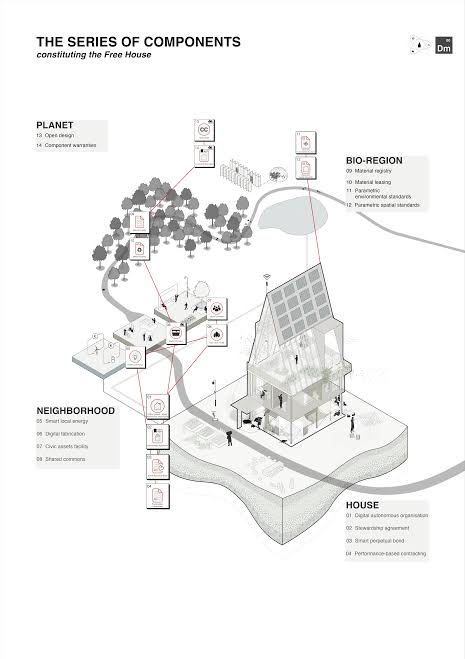
We take it for granted that every house must have an owner. Entire legal and financial systems are built around that assumption. Architect and systems designer Indy Johar asks whether some of our housing problems might stem from the way ownership itself is organised. Through FreeHouse, he is testing how a house could be held through long-term community stewardship contracts rather than private ownership. Here, ‘community’ includes people, but also trees, rivers and the house itself. The experiment asks what changes when property is treated less as a possession and more as a relationship. Emergence Trust supports FreeHouse’s next step: turning the idea into a full-scale house that people can enter and experience.
Some questions don’t belong to any one person or field. A farmer exploring new forms of ownership might have more in common with a lawyer, artist or ecologist than with someone else in their own field. We bring people together around questions. Some gatherings are small; others are public, opening the inquiry to people beyond our existing network. People bring different experiences and kinds of knowledge. Sometimes new collaborations and experiments follow.
Some questions take the form of organisations: a housing co-operative based on stewardship rather than ownership, new forms of governance shaped around the needs of a river, or a creative agency whose clients aren’t only human. These experiments bring ideas into contact with law, money, institutions and everyday life. They make alternatives tangible so others can see, try and build on them. We offer early-stage funding to create new kinds of organisations or reshape existing ones.
We follow what happens between and beyond the work we support. Where are similar questions appearing? What unexpected alliances are forming? What’s changing in practice? What’s meeting resistance? Where is money flowing, or strangely absent?
Each month, Signals shares what people in our network are noticing at the edges of different fields. Once a year, Shifts steps back to ask what might be changing in culture more broadly – and what new questions that raises.
We find the people we fund through relationships and experiments developing around questions, rather than through a competitive process. So, we don’t accept unsolicited applications. But we don’t want this to become a closed circle. People we support introduce us to others who might approach a question differently or take it somewhere new. Our public gatherings are another way to meet people beyond our existing networks.
If you’d like to hear from us, subscribe to Signals & Shifts for observations from across different fields and invitations to public gatherings. If you’re working on something that connects with the questions we’re exploring, you can get in touch through our contact form. As a small trust, we can’t respond to every enquiry, but where there’s a useful connection to make, we’ll do our best to make it.